

Invisalign for Kids & Teens in Bangalore
Advanced Invisalign Solutions for Growing Smiles
Early Orthodontic Care. Designed Around Growth.
Children's orthodontic treatment is not simply about straightening teeth. During childhood and adolescence, the teeth, dental arches, bite and jaws are continuously developing.
The Invisalign® growing-patient portfolio provides orthodontists with different tools for different stages of development - from early Phase 1 treatment to comprehensive treatment for growing teens.
At Invisalign Smile Centre, we assess your child's dental development, bite, jaw relationship and growth stage before recommending whether treatment, monitoring or another orthodontic approach is appropriate.
Our Invisalign Solutions for Growing Patients
Invisalign First™ | Invisalign Palatal Expander System | Invisalign with Mandibular Advancement
Why Is Age 7 an Important Orthodontic Milestone?
The American Association of Orthodontists recommends that children have their first orthodontic check-up no later than age 7.
This does not mean every child should start orthodontic treatment at seven.
Rather, an early assessment allows the orthodontist to identify developing concerns and determine whether your child should:
Start treatment → Be monitored → Receive early intervention → Wait until a later stage
At around this age, children are developing a mixture of primary and permanent teeth, making it possible to assess eruption, spacing, crowding, bite and jaw development.
Invisalign for Growing Children
Three Invisalign Solutions for Different Stages of Development
Your child's age alone does not determine the treatment.
The appropriate Invisalign solution depends on what is developing, the child's dentition, bite, jaw relationship and stage of growth.
1. Invisalign First™
Clear Aligners Designed for Growing Children
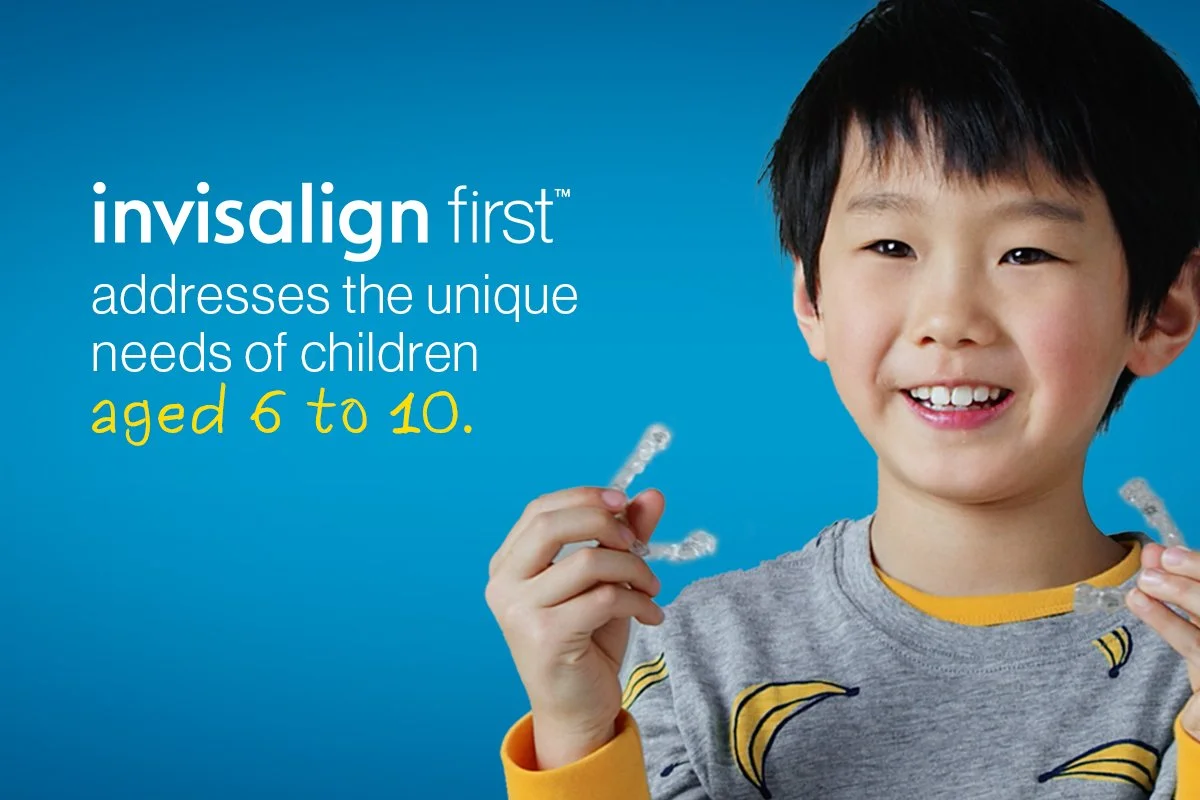
Invisalign First™ is designed for growing children, and Invisalign currently positions it for children approximately 6–10 years old. It is intended for Phase 1 orthodontic treatment and addresses a broad range of developing malocclusions.
Invisalign First Can Be Used to Address:
• Crowding
• Spacing
• Developing malocclusions
• Arch development
• Certain crossbite and bite concerns
• Alignment of primary and permanent teeth
• Space management for erupting permanent teeth
The treatment is designed around the changing dentition of growing children rather than simply adapting an adult aligner system.
Why Parents Consider Invisalign First
• Clear aligners instead of traditional brackets and wires
• Removable for eating and oral hygiene
• Designed specifically for growing patients
• Digital treatment planning
• Can be incorporated into Phase 1 orthodontic treatment
Whether Invisalign First is appropriate depends on your child's clinical needs and ability to follow the treatment routine.
2. Invisalign® Palatal Expander System
Creating Space for Developing Permanent Teeth
Some children have a narrow upper dental arch that may contribute to crowding or crossbite.
The Invisalign Palatal Expander System is designed for growing patients and is currently marketed for children approximately 6–11 years old. It uses a series of custom 3D-printed expanders to gradually widen the upper arch and create space for developing permanent teeth.
What Can a Palatal Expander Help Address?
Depending on the child's diagnosis, expansion may be considered for:
• Narrow upper arches
• Certain posterior crossbites
• Lack of arch width
• Insufficient space for developing permanent teeth
• Selected developing orthodontic problems associated with a constricted upper arch
The clinical indication must be determined through an orthodontic assessment.
Invisalign Palatal Expander + Invisalign First™
One of the important advantages of the current Invisalign growing-patient portfolio is that palatal expansion and dental alignment can be incorporated into an overall Phase 1 treatment plan when clinically appropriate.
The Invisalign provider information specifically describes the Palatal Expander System as being able to transition into or be combined with Invisalign First™, providing an approach that can address both arch expansion and tooth alignment.
In Simple Terms:
Expand where necessary → Create appropriate space → Guide developing teeth → Align the smile
Not every child requires all of these steps.
3. Invisalign® System With Mandibular Advancement
Invisalign for Growing Tweens & Teens With Class II Bite Problems
For older growing children and teenagers, Invisalign offers another specialised solution: Invisalign treatment with mandibular advancement.
This is intended for selected growing patients with retrognathic Class II malocclusions, particularly those in permanent dentition or stable late mixed dentition.
Instead of simply aligning the teeth, the treatment combines tooth alignment with a mechanism designed to encourage forward positioning of the lower jaw during growth.
Mandibular Advancement With Enhanced Precision Wings
The current Invisalign system includes Enhanced Precision Wings integrated into the aligners for appropriate growing patients with Class II malocclusion.
This allows the orthodontist to combine:
Tooth alignment + Bite correction + Mandibular advancement
within the Invisalign treatment approach.
Mandibular Advancement With Occlusal Blocks
Invisalign also offers an Occlusal Blocks solution for mandibular advancement.
The integrated blocks are designed to address Class II malocclusion while simultaneously aligning the teeth, reducing the need for multiple separate appliances in appropriate cases.
This is particularly relevant when treating growing patients with Class II bite relationships, including selected cases with more significant deep-bite characteristics.
Which Invisalign Solution Is Right for My Child?
Stage / Concern
Invisalign Solution
Growing child with developing orthodontic problems
Invisalign First™
Narrow upper arch / selected expansion needs
Invisalign Palatal Expander System
Expansion + developing tooth alignment
Palatal Expander + Invisalign First™
Growing tween/teen with suitable Class II malocclusion
Invisalign with Mandibular Advancement
Teen with conventional alignment concerns
Invisalign Teen / Invisalign treatment
The table is a general guide, not a treatment recommendation. The appropriate solution depends on the child's clinical examination, dental development and growth pattern.
Invisalign for Kids: What Problems Can Be Identified Early?
An orthodontic assessment can identify developing concerns such as:
Crowding
Insufficient space for permanent teeth to erupt and align.
Narrow Upper Arch
A constricted upper arch that may contribute to crossbite or inadequate space.
Crossbite
Upper and lower teeth do not meet in the expected relationship.
Excessive Overjet
Upper front teeth appear significantly ahead of the lower teeth.
Class II Bite
The lower jaw and/or lower teeth are positioned relatively behind the upper jaw/teeth.
Spacing
Excessive or abnormal spaces between teeth.
Eruption Problems
Permanent teeth may be delayed, displaced or lacking adequate space.
Developing Jaw Discrepancies
Differences in the relationship between the upper and lower jaws may become more apparent during growth.
How We Assess a Growing Smile
1. Orthodontic Consultation
We assess your child's:
• Teeth
• Bite
• Dental arches
• Jaw relationship
• Facial growth
• Tooth eruption
• Available space
2. Digital Scan
An intraoral digital scan can create a detailed 3D model of your child's teeth without conventional impression material. Invisalign highlights iTero scanning as part of its growing-patient digital workflow.
3. Growth & Development Assessment
We determine whether the orthodontic concern is something that should be treated now, monitored or addressed later.
4. Treatment Planning
Depending on the diagnosis, the plan may involve:
Monitoring | Invisalign First | Palatal Expansion | Invisalign + Mandibular Advancement | Later Comprehensive Invisalign Treatment
5. Digital Treatment Simulation
Where Invisalign treatment is appropriate, digital treatment planning can help map the planned tooth movements and communicate the treatment approach.
Why Early Orthodontic Assessment Matters
Early assessment doesn't mean early treatment for every child.
Sometimes the most appropriate plan is simply:
“Let's monitor growth.”
Other children may benefit from intervention while they are still growing.
The important thing is identifying what your child's smile needs and when it needs it.
Invisalign for Kids vs Traditional Braces
Both clear aligners and braces have an important role in orthodontics.
Invisalign Growing-Patient Solutions
• Clear
• Removable
• Digital treatment planning
• Designed for different stages of growing patients
• Supports oral hygiene when aligners are removed
• Includes specialised solutions for expansion and selected Class II cases
Traditional Orthodontic Appliances
• Fixed appliances in many cases
• Brackets and wires
• Various specialised appliances available for growth modification and expansion
• Can be appropriate for a wide range of orthodontic conditions
The appliance should be selected based on the diagnosis-not simply because it is clear or removable.
Why Choose Invisalign Smile Centre for Kids & Teens?
Invisalign-Focused Orthodontic Care
Our practice focuses strongly on Invisalign and digital orthodontic treatment planning, including treatment for growing patients.
Orthodontist-Led Assessment
Growing patients require assessment of more than tooth alignment. Bite, eruption, arch development and jaw relationships are considered.
Complete Growing-Patient Portfolio
Depending on the child's needs, assessment may include:
• Invisalign First™
• Invisalign Palatal Expander System
• Invisalign with Mandibular Advancement
• Teen Invisalign Solutions
Digital Dentistry
Digital scanning and 3D treatment planning allow us to evaluate and communicate orthodontic treatment in a contemporary way.
Individualised Treatment Timing
We don't believe every child should start treatment simply because they have reached a particular age.
The right question is:
“What does this child need, and when is the right time to provide it?”
Frequently Asked Questions
What age can a child start Invisalign First?
Invisalign states that Invisalign First is designed for children approximately 6–10 years old. Actual treatment suitability depends on dental development and the orthodontic condition.
What age is the Invisalign Palatal Expander for?
Invisalign currently describes its Palatal Expander System for children approximately 6–11 years old.
What is Invisalign Mandibular Advancement?
It is an Invisalign treatment approach designed for selected growing patients with Class II malocclusion, combining tooth alignment with mandibular advancement mechanics.
Can Invisalign First and a Palatal Expander be used together?
Yes, Invisalign's provider information describes the Palatal Expander System as part of a comprehensive early-treatment approach that can transition to or be combined with Invisalign First when clinically appropriate.
Is age 7 the right age to start Invisalign?
Not necessarily. Age 7 is an important age for an orthodontic assessment, not a universal treatment-start age. Some children need treatment early, while others are best monitored until more permanent teeth erupt.
Can Invisalign treat a child's overbite or underbite?
Invisalign growing-patient solutions can address selected bite problems, but the appropriate treatment depends on the type and severity of the malocclusion and the child's stage of growth.
Does my child need all permanent teeth before Invisalign?
No. Invisalign First is specifically designed for growing children with developing dentition, including children who still have primary teeth.
Invisalign for Kids & Teens in Bangalore
Start With an Assessment. Not an Assumption.
Your child's smile is developing every day.
Whether your child needs early Phase 1 orthodontic treatment, palatal expansion, Invisalign First, mandibular advancement or simply periodic monitoring, the first step is understanding how the teeth and jaws are developing.
Author’s Bio:
Dr Deesha Rajendran - Dentist, Invisalign Expert & Founder, Invisalign Smile Centre. She leads a Diamond Tier Invisalign Provider Clinic - the highest certification tier - held for five consecutive years and the first in Karnataka. She leads the clinic’s comprehensive consultation and digital dentistry practice.